Pricing research · 3 days · October 2026
Carta Pricing in 2026: What VC Funds and Startups Pay
Carta lists four equity plans and two fund plans, and prices none of them beyond the free tier. Here is what contract data and 317 public reviews say about the real bill.
Summary
Carta pricing is free up to 25 stakeholders and $1M raised, then quote-only. Vendr's data on 406 purchases puts the median contract at $15,450 a year, with seed companies paying $3,000 to $8,000. Fund administration sits on a separate price list with no public figures. G2 rates Carta 4.3/5 across 232 reviews, Capterra 4.2/5 across 66, Trustpilot 2.0/5 across 19. Read this before you ask for a quote: stakeholder caps, renewal escalators and add-ons decide the final bill.
Carta pricing is free for companies under 25 stakeholders and $1M raised, then quote-only. Buyer data from 406 purchases shows a $15,450 median annual contract. Carta is the investor-standard cap table, but cost climbs with every stakeholder, and fund administration is priced on a separate, unpublished list.
- Price transparency
- 4/10
- Product breadth
- 9/10
- Fit for small funds
- 6/10
- Ease of use
- 7/10
- Support
- 5/10
- Free Launch tier covers 25 stakeholders and $1M raised, enough for a first cap table
- G2 reviewers give 4.3/5 across 232 reviews, 73% of them five-star
- One vendor spans cap table, 409A, SAFE closings and VC fund administration
- No published price above the free tier: Build, Grow, Scale and both fund plans all say contact sales
- Renewal escalators of 5 to 10% and stakeholder overages of $20 to $50 each appear in buyer contract data
- Trustpilot sits at 2.0/5 across 19 reviews, with cancellation and support complaints repeated
Free tier, no card. Paid plans need a sales call.
How we researched this
- Tested for
- 3 days
- Plan paid
- No paid plan. Public pages and the free Launch tier description only; paid tiers are quote-only.
- Version tested
- Carta public pricing pages and Vendr marketplace data, snapshot of 14 to 16 October 2026
- Test period
- 2026-10-14 → 2026-10-16
Carta does not publish prices above its free tier, so a hands-on test would only show us a sales quote for one company. Instead we read Carta's own equity and VC fund pricing pages on 15 and 16 October 2026 and recorded which features sit in which tier. We then took buyer-side contract figures from Vendr's Carta page, which reports 406 purchases. Finally we collected rating, review count and recurring themes from G2, Capterra and Trustpilot, plus a Reddit thread on a renewal quote. Every number in the testing section carries its source. Where two sources disagree, as they do on 409A valuations, we say so. Vendr and review-site figures are estimates of what others paid, not a quote for your cap table.
Is Carta worth a quote?
YES if you...
- Seed to Series A companies that expect investors to ask for a Carta cap table
- Emerging VC managers with an audited fund who want fund admin, LP portal and cap table data in one login
- Finance teams that need 409A valuations and ASC 718 reporting from the same vendor
NO if you...
- Pre-seed teams with under 10 stakeholders who can stay on the free Launch tier or a spreadsheet
- Funds under $20M that only need a basic cap table view of portfolio companies
- Buyers who want a published price before talking to sales
Carta plans and what each one gates
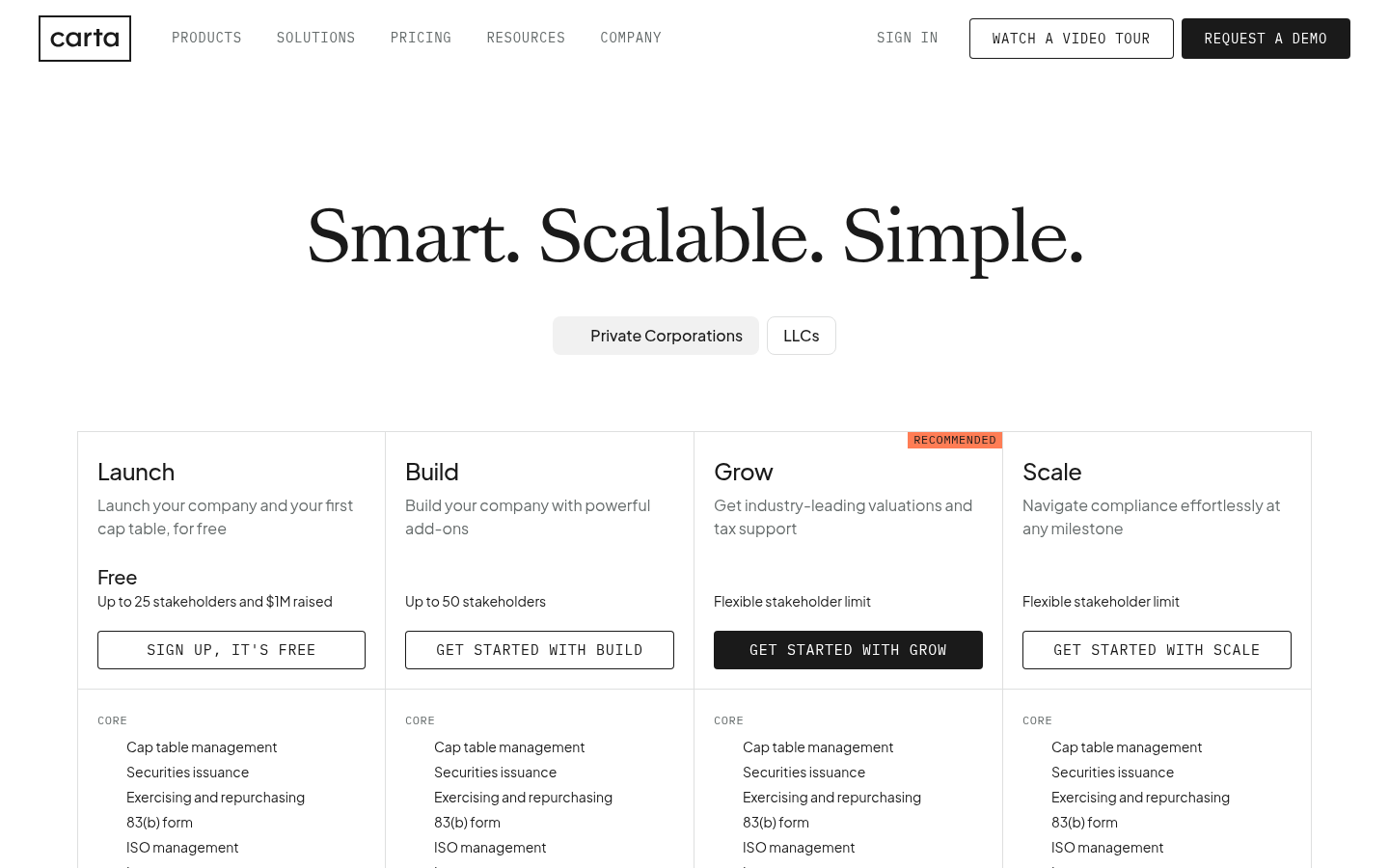
Plan names and features come from Carta's pricing pages, read 15 and 16 October 2026. Only Launch shows a price.
Launch
For companies that raised up to $1M
- Cap table management and securities issuance
- 83(b) form and ISO management
- SAFE modeling, fundraising and closings
- Email, chat and phone support
Build
Adds round modeling and onboarding
- Everything in Launch
- Priced round modeling
- Deal Closings and Deal Pro Forma
- White-glove onboarding
Grow
Carta marks this plan Recommended
- Everything in Build
- 409A valuations and audit support
- Form 3921
- Board meetings
Scale
Compliance and exit work
- Everything in Grow
- ASC 718 and IFRS reporting with audit support
- Rule 701 management
- Exit modeling, IPO advisory, admin SSO
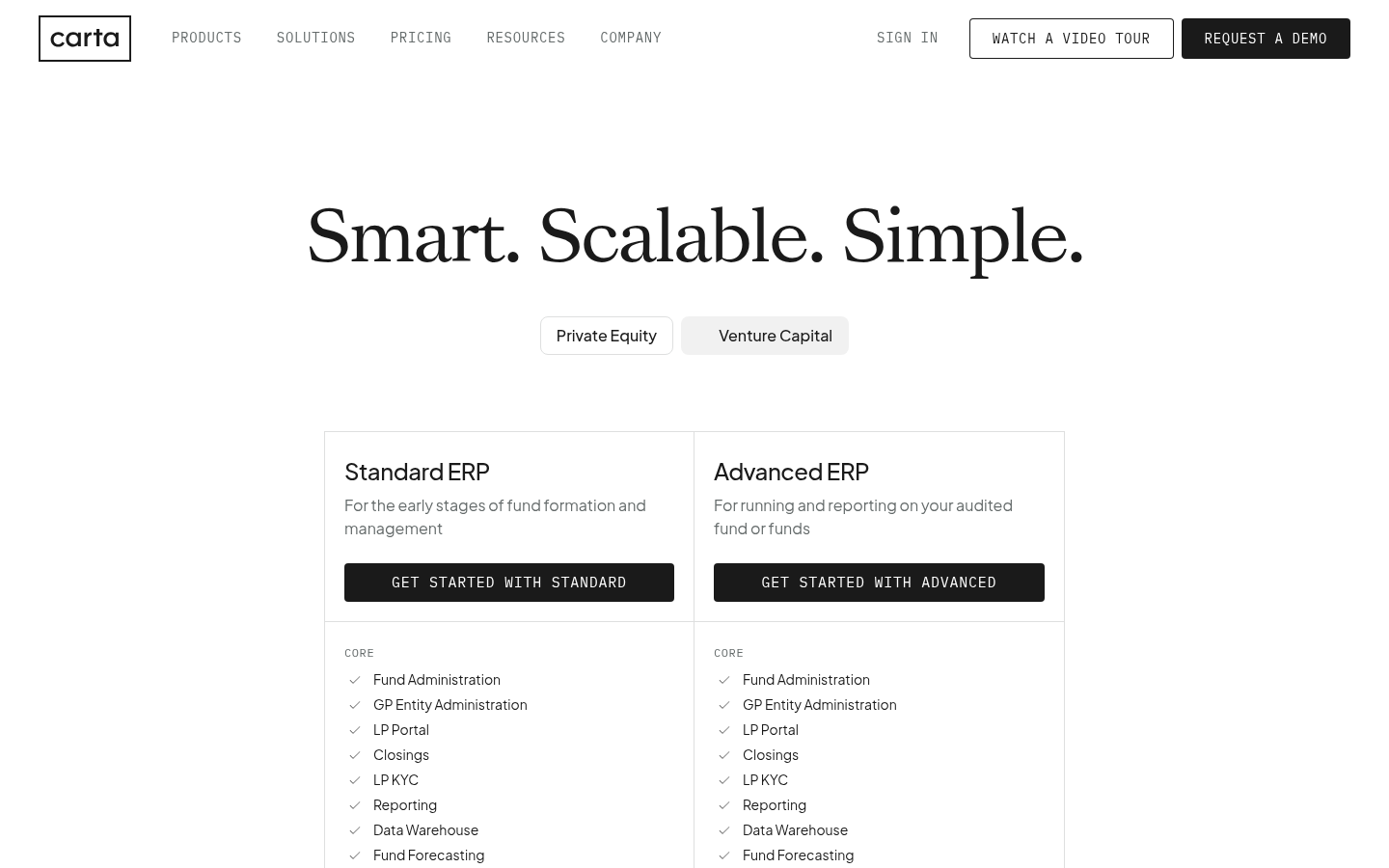
VC Fund ERP
Standard or Advanced ERP
- Fund and GP entity administration, LP portal, closings, LP KYC
- Advanced adds CRM, GP carry tracking, auditor portal, API access
- Fund tax, formations and valuations sold as add-ons
ROI breakdown: Using Vendr's $15,450 median, a company paying that for a year spends about $1,290 a month. A seed company in the $3,000 to $8,000 band spends $250 to $670 a month. The free tier saves that entire amount until you pass 25 holders or $1M raised.
Hidden costs & gotchas
- Stakeholder overages of $20 to $50 per extra holder when you pass your contract cap (Vendr)
- Annual price escalators of 5 to 10% in many contracts, and 5 to 15% proposed at renewal (Vendr)
- Onboarding or migration fees of $1,000 to $5,000, often negotiable (Vendr)
- 409A valuations at $2,000 to $5,000 each where quoted outside the plan (Vendr)
- Total Compensation, Equity Advisory, Liquidity and QSBS Attestation sold as separate add-ons (Carta)
- Fund Tax, Fund Formations, Manco Admin and portfolio valuation add-ons on the fund side (Carta)
What we measured
Eight figures, each tied to a named source. Vendr and review sites report what others paid and said, not your quote.
- Free Launch ceiling
- 25 stakeholders and $1M raised carta.com plans page, read 15 Oct 2026
- Median annual contract
- $15,450 per year Vendr, 406 purchases, range $2,947 to $55,413
- Seed band, under 50 stakeholders
- $3,000 to $8,000 per year Vendr buyer data
- G2 rating, Carta Equity Suite
- 4.3 /5 232 reviews, 73% five-star, 5% one-star
- Capterra rating
- 4.2 /5 66 reviews; value for money 3.7 (35 ratings), customer service 3.8 (40)
- Trustpilot rating
- 2.0 /5 19 reviews, labelled Poor
- Pulley list price gap
- 20 to 40% lower than Carta Vendr comparison, early and growth stage
- VC fund admin, per fund
- $5,000 to $50,000+ per year Vendr estimate; Carta publishes no fund price
What does the free tier actually cap?
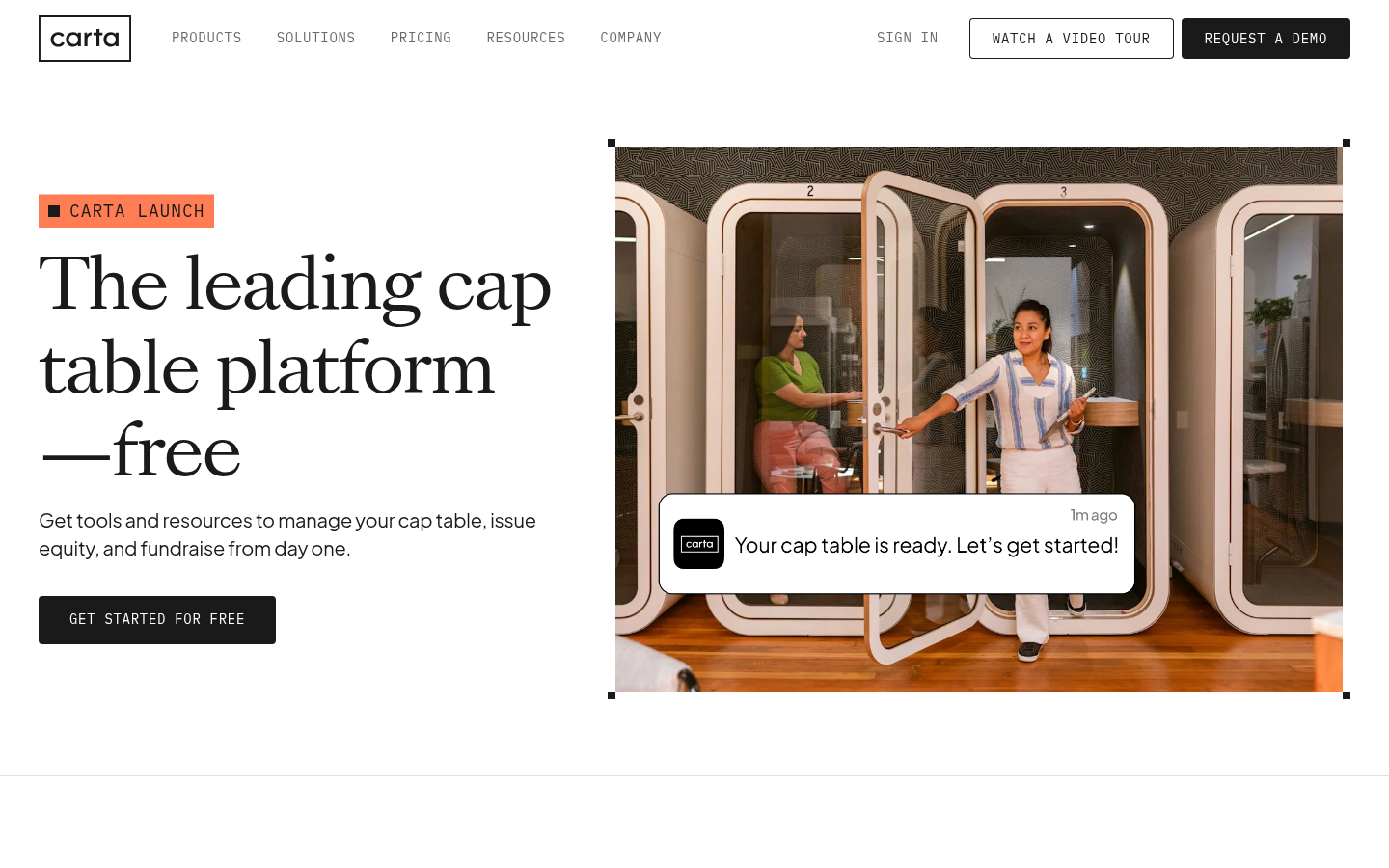
Is there a free path for a first-time founder?
What does a VC manager get on the fund side, and at what price?
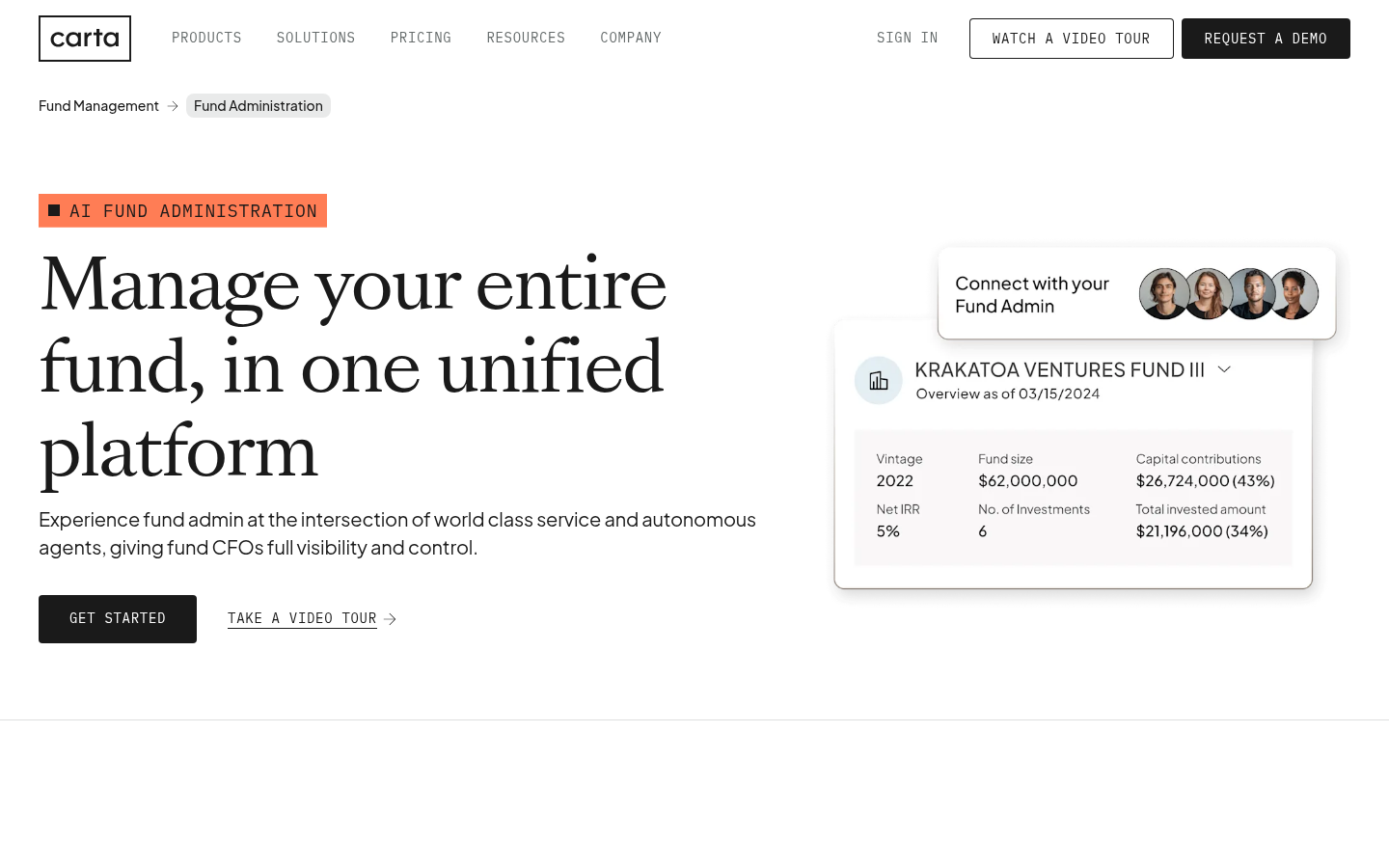
What does the fund admin product show a GP?
Pros and cons
Pros
- Free tier is real, with a clear ceiling 25 stakeholders and $1M raised is written on the plans page. A pre-seed company can hold a cap table and issue SAFEs at no cost.
- Investors already recognise the cap table A G2 reviewer notes that when mutual investors use Carta, the platform becomes the default for the round.
- Breadth across the company and the fund Equity, 409A, ASC 718, fund accounting, LP portal and carry tracking sit under one vendor, which reduces reconciliation work between systems.
- High satisfaction among paying admins G2 summarises 26 mentions of ease of use and 24 of equity management as top positives.
Cons
- No public price above the free tier Build, Grow, Scale, Standard ERP and Advanced ERP all route to a sales call. A buyer cannot budget before talking to Carta.
- Cost rises with every stakeholder G2 records 12 mentions of price as the top complaint, and Capterra reviewers say paid plans grow quickly with headcount or shareholders.
- Support quality is uneven Capterra scores customer service 3.8 across 40 ratings. G2 has 7 mentions of poor support, and Trustpilot has repeated reports of slow replies.
- US-first product design A G2 reviewer says global employees struggle to sign up, and a Trustpilot reviewer reports UK customers were moved to the US version without equivalent features.
Verdict: worth a quote, not a blank cheque
Carta earns its place as the default cap table that investors recognise, and the free tier makes the first 25 stakeholders a non-decision. Past that point you are buying on a quote, and the public record says the bill grows with stakeholders, add-ons and renewals.
For a startup, ask for a written stakeholder cap, a cap on annual escalators and the onboarding fee in the first quote. Vendr's data suggests those three items move the total most. Get one competing quote before you sign.
For a VC manager, the question is different. Fund administration has no public price, so the quote is the only data point. Compare it against your current administrator line by line, and check whether the Advanced ERP extras such as CRM and carry tracking replace tools you already pay for.
The review-site spread is wide. G2 and Capterra users mostly like the product, while Trustpilot is poor, and the common thread in the negative reviews is support and cancellation. Read your renewal terms before you sign, not after. We score Carta 6.8 out of 10 on price, with product breadth pulling the number up and transparency pulling it down.
- Price transparency 4/10 Only the free tier is priced
- Product breadth 9/10 Cap table to fund admin
- Fit for small funds 6/10 Quote-only, no fund price
- Ease of use 7/10 G2 praises UI, Trustpilot does not
- Support 5/10 Capterra 3.8 across 40 ratings
Common questions
How much does Carta cost?
Is Carta really free?
Does Carta include 409A valuations?
What does Carta cost for a VC fund?
Is Carta cheaper than Pulley?
Can you negotiate Carta pricing?
Why is Carta's Trustpilot rating so low?
Update log
- Initial publication. Pricing pages, Vendr data and review-platform figures captured 14 to 16 October 2026.